
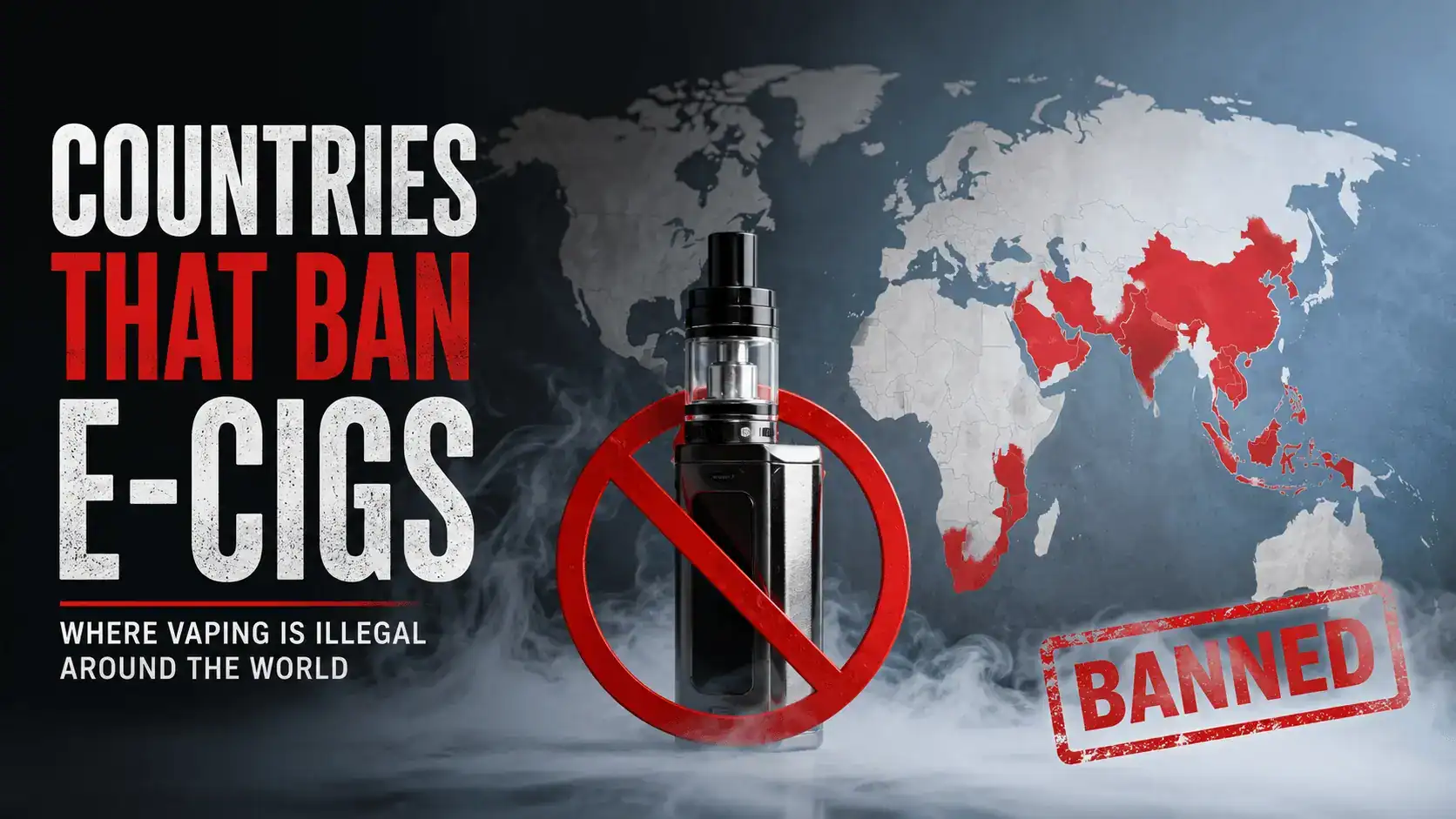
Countries That Have Banned Vapes and Vaping in 2026
Updated 2026-06-29 — Originally published 2019-03-04
Planning a trip abroad with your vape in your bag? Read this first. As of 2026, at least 47 countries have imposed outright bans on e-cigarette sales, possession, or use — and the list keeps growing. Get caught in the wrong place and you’re facing heavy fines, confiscation, or jail time.
This isn’t just about knowing the rules. It’s about not ruining your vacation — or your freedom.
Key Takeaways
- At least 47 countries have fully banned e-cigarette and vaping sales as of 2026
- Penalties range from small fines to multi-year prison sentences depending on the country
- Many countries ban only nicotine-containing e-liquids — nicotine-free products may still be allowed
- The EU has banned single-use disposable vapes across several member states since February 2025 and caps nicotine at 20mg/mL
- Always verify the laws of your destination before you travel — don’t assume vaping is fine just because it’s legal at home
Why These Bans Exist
Countries Where Vaping Is Restricted
Countries Where Vaping Is Fully Banned
Quick Reference Table
Traveling With Your Vape: What You Need to Know
Why These Bans Exist
Most governments that ban vaping fall into one of two camps. Either they treat e-cigarettes as tobacco products and apply every existing tobacco law to them — or they classify nicotine itself as a controlled or poisonous substance. A few countries simply followed WHO guidance and banned them outright while research was still catching up.

Some of these bans make sense. Others feel more like political posturing than genuine public health policy — especially when cigarettes remain freely available on the same street corners where vaping is outlawed. But whether you agree with the laws or not, they’re real and they carry real consequences.
For a broader look at vaping health data, our vaping statistics and facts guide pulls together over 80 sourced data points.
Countries Where Vaping Is Restricted
These countries haven’t banned vaping outright, but they’ve put meaningful restrictions in place. Know what you’re walking into before you pack.
Australia — The rules tightened hard in 2024. You now need a prescription to legally purchase nicotine vaping products nationwide. No prescription means it’s illegal, full stop. Nicotine-free e-liquids sit in a gray area depending on the state.
Japan — You can vape, but you can’t bring more than 120ml of e-liquid into the country. Buying e-liquid locally is illegal, even if the product looks legitimate in a shop window. Heat-not-burn devices like IQOS dominate the market there instead.

Hong Kong — This one surprises a lot of travelers. Owning or using nicotine-containing e-liquids can carry up to two years in prison. Nicotine is classified as a poison under Hong Kong law. Don’t test it.
Canada — Legal, with a minimum purchase age of 19 in most provinces. Individual businesses set their own rules on where vaping is permitted.
New Zealand — E-cigarettes are regulated identically to combustible cigarettes. Minors can’t buy them, vaping is banned in workplaces and restaurants, and advertising is heavily restricted.
Switzerland — Nicotine-containing e-cigarettes can’t be sold. Nicotine-free products are treated as general commodities and remain legal.
Norway — E-cigarette advertising is banned. Nicotine e-liquids must be imported from EEA member states only, and solely for personal use.
Finland — Advertising is prohibited. A separate law bans vaping on balconies and in shared public spaces.
Denmark — The Danish Medicines Agency treats nicotine e-liquids as medicinal devices requiring a license to advertise. No licenses have been issued.
Hungary — Legal purchase age is 18. Nicotine e-liquids can only be sold in state-run National Tobacco shops, capped at 10ml per bottle.
South Africa — Nicotine e-cigarettes are legal but classified as Class 3 medicines, which means they face pharmaceutical-level scrutiny.
Iran — E-cigarettes fall under the same laws as tobacco products, covering sales, use, and distribution.
Countries Where Vaping Is Fully Banned
These are the places where traveling with a vape device is a genuine legal risk. This is the core of what people need to understand about countries that have banned e cigs and vaping — and the penalties vary wildly.
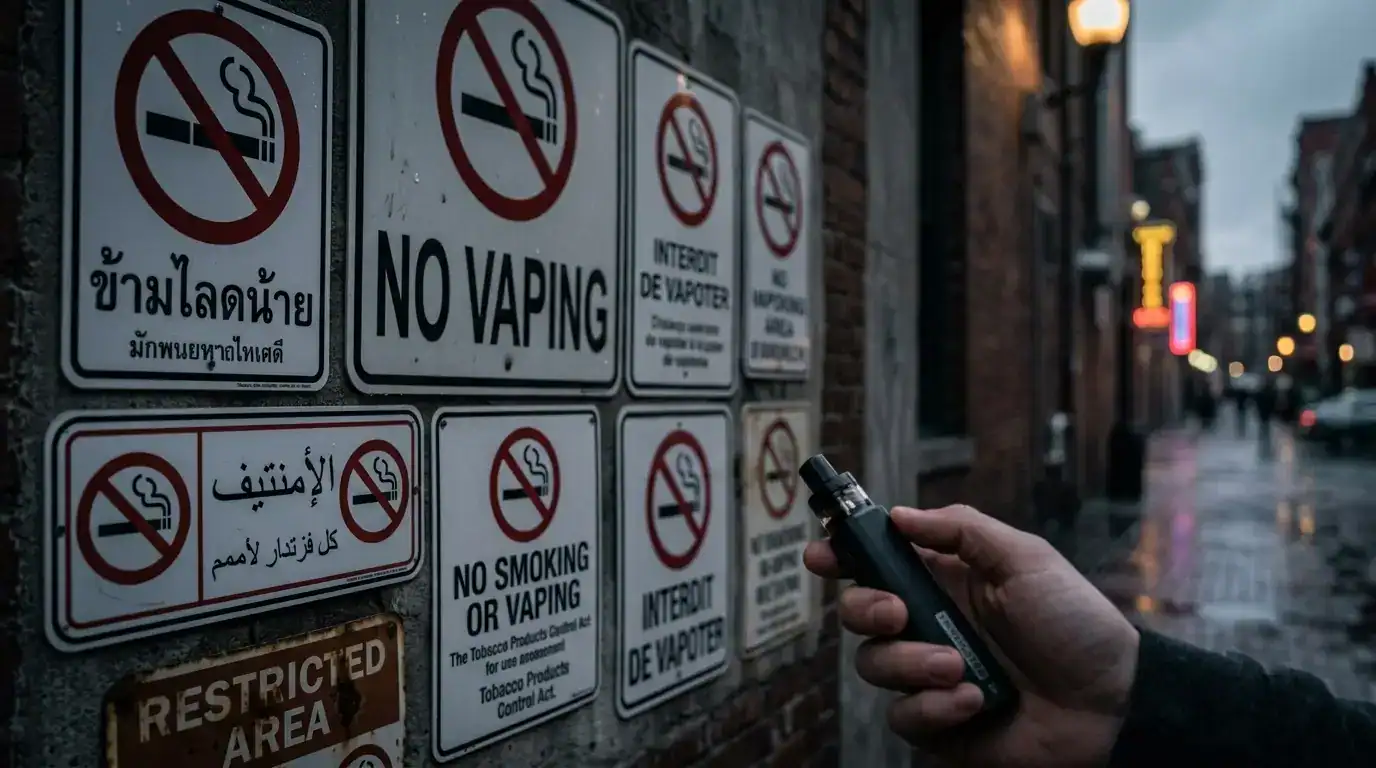
Thailand deserves a specific warning. It’s one of the most popular tourist destinations for Americans, and it runs one of the most aggressively enforced vaping bans on the planet. Tourists have been arrested, fined thousands of dollars, and jailed. Leave your device at home.
Singapore is equally unforgiving. E-cigarettes are classified as imitation tobacco products. Fines for possession can exceed $1,500 USD, and importing devices — even for personal use — carries criminal charges.
Taiwan classifies e-cigarettes as drugs. Use leads to fines and potential imprisonment.
India banned production, import, sale, and advertising of e-cigarettes in 2019. The ban remains fully in force.
| Country | Key Details | Penalty Level |
|---|---|---|
| Argentina | Full ban on sales, advertising, distribution, and use | High |
| Bahrain | Sale and import prohibited | High |
| Brazil | Manufacture and sale banned; reinforced in 2023 | High |
| Brunei | Manufacturing, selling, importing prohibited | High |
| Cambodia | Full import and sales ban | High |
| Colombia | Cannot be sold, purchased, or imported; banned on public transport | High |
| Egypt | Banned following WHO recommendations | Medium–High |
| India | Production, import, sale, and advertising banned since 2019 | High |
| Indonesia | Heavily restricted; treated as tobacco product | Medium |
| Jordan | Full ban on import and sale | High |
| Malaysia | Sale of nicotine e-liquids banned; enforcement increasing | Medium–High |
| Mexico | Sale, distribution, promotion, and manufacturing all banned | High |
| Nicaragua | Import and sale prohibited | Medium |
| North Korea | Banned under broad anti-tobacco policies | Extreme |
| Oman | Full ban | High |
| Panama | Nicotine-containing e-cigarettes forbidden | High |
| Qatar | Full ban; enforced at airports and in public spaces | High |
| Singapore | Classified as imitation tobacco; fines and imprisonment for possession | Very High |
| Sri Lanka | Sale of nicotine e-cigarettes prohibited | High |
| Taiwan | Classified as drugs; fines and prison sentences | Very High |
| Tajikistan | Full ban on use and sale | High |
| Thailand | Full ban; actively enforced against tourists | Very High |
| Turkey | Sale prohibited; enforcement has tightened significantly | High |
| UAE | Partial restrictions remain; verify current rules before traveling | Medium–High |
| Uganda | Full ban on import, sale, and use | High |
| Uruguay | Full ban since 2009 | High |
| Venezuela | Sale and advertising banned | Medium |
Quick Reference Table

| Status | Examples | What It Means for Travelers |
|---|---|---|
| Full Ban | Thailand, Singapore, Brazil, India | Leave your vape at home — no exceptions |
| Nicotine Ban Only | Switzerland, Malaysia, Japan (liquid) | Nicotine-free products may be OK — verify first |
| Prescription Required | Australia | No prescription = illegal; don’t bring nicotine e-liquids |
| Heavy Restrictions | Canada, New Zealand, Norway | Legal but with age limits and location restrictions |
| EU Disposable Ban | France, Germany, Belgium | Single-use disposables banned from February 2025; refillables still permitted |
Traveling With Your Vape: What You Need to Know
The single biggest mistake vapers make when traveling internationally is assuming the rules match home. They don’t. Not even close.
Before any international trip, check whether your destination appears on any list of countries that have banned e cigs and vaping — then dig one level deeper to understand whether the ban covers possession, sale, or both. Some countries are fine with you vaping in a hotel room but will fine you for doing it in public. Others will confiscate your device at the airport before you even clear customs.
✓ Smart Travel Habits for Vapers
- Pack your device in carry-on luggage only — airlines prohibit vapes in checked bags
- Bring enough e-liquid for your full trip; don’t count on buying it locally
- Check nicotine strength rules — many countries cap at 20mg/mL
- Research indoor vaping rules for hotels, restaurants, and transit
✗ Mistakes That Get Vapers in Trouble
- Assuming another country’s laws mirror your own
- Traveling to Thailand, Singapore, or Brazil with any vaping device
- Trying to buy e-liquid locally in Japan — illegal even in legitimate-looking stores
- Ignoring hotel vaping policies, which can trigger significant fines
Our dedicated guide on flying with e-cigs and vapes covers airline rules, TSA policies, and what to do at international customs in more detail.
If you’re newer to vaping and still figuring out what device works for you, the vaping for beginners guide is worth a read before you add travel planning to the mix.
Frequently Asked Questions
Can I fly internationally with an e-cigarette?
You can carry e-cigarettes and vaping devices on most international flights, but they must go in your carry-on bag — not checked luggage. This is a standard aviation safety rule enforced by virtually every airline. The bigger issue is your destination: carrying a device onto a plane means nothing if you land somewhere like Thailand or Singapore where possession itself is illegal.
Has Japan banned vapes?
Japan hasn’t issued a full ban on e-cigarettes, but restrictions are real. You can bring your device and vape during your stay, but you’re limited to 120ml of e-liquid on entry and you cannot buy e-liquid locally — that’s illegal regardless of where the product is sold. Heat-not-burn devices like IQOS are widely available and legally sold across Japan, which is where most of the market has shifted.
Which countries have the harshest penalties for vaping?
Thailand, Singapore, and Taiwan carry the most severe enforcement. Thailand has jailed tourists for possession. Singapore fines can exceed $1,500 USD, with criminal charges for importing devices. Taiwan classifies e-cigarettes as drugs, which means both fines and potential imprisonment. North Korea technically bans them too — though that’s rarely a travel concern for most Americans.
Can lungs recover after years of vaping?
Research on long-term lung recovery after vaping is still limited compared to what we know about smoking cessation. Some studies suggest airway inflammation can improve after stopping, but the timeline and degree of recovery vary depending on how long someone vaped, at what nicotine levels, and whether they also smoked combustible cigarettes. Anyone with specific concerns should consult a pulmonologist directly.
Can you vape with an IUD?
An IUD has no direct interaction with vaping or e-cigarette use — it’s a localized contraceptive device. The real concern is nicotine, which affects cardiovascular health and circulation regardless of what contraceptive method you use. If you have health concerns about nicotine use alongside any medication or device, talk to your doctor rather than relying on vaping-specific guidance.
Is the EU moving toward a full vaping ban?
No — the EU isn’t heading toward an outright ban, but regulations are getting stricter. Multiple EU member states banned single-use disposable vapes from February 2025, driven largely by environmental waste concerns. The EU’s Tobacco Products Directive already caps nicotine at 20mg/mL and restricts tank and bottle sizes. Refillable devices and compliant pod systems remain legal across most of the EU.
Sources
- WHO Global Tobacco Control Report (2024)
- GGTC Fact Sheet: E-Cigarette Ban & Regulation (June 2025)
- Framework Convention Alliance — Country-by-Country Regulatory Status
- Australian Therapeutic Goods Administration — Nicotine Vaping Products Regulations (2024)
- Singapore Health Sciences Authority — Regulatory Guidelines on Imitation Tobacco Products


