
Vaping Statistics & Facts 2026
This page presents published research findings and public health data. It is not medical advice. If you have health concerns about vaping or smoking, consult a healthcare professional.
All statistics sourced from peer-reviewed research, government agencies, and official health bodies. Every figure includes its original source. Full source list at bottom. Last updated: June 2026.
Contents
- US Vaping Overview
- US Youth Vaping Statistics
- Global Vaping Market & Growth
- Who Vapes Worldwide
- Health & Harm Reduction Statistics
- Vaping vs Smoking Comparison
- US Regulatory Landscape
- Economic & Industry Statistics
- Environmental & Sustainability
- Methodology & Sources
- How to Cite & Embed
- FAQ
Key Statistics at a Glance
- 6.5% of US adults (approx. 17 million) currently use e-cigarettes (CDC NHIS, 2023)
- 1.63 million US middle and high school students currently vape — down from 5+ million at the 2019 peak (CDC NYTS, 2024)
- $45.7 billion global vaping market size in 2025 (Grand View Research, 2025)
- 129 million estimated adult vapers worldwide (GSTHR, 2025)
- 2,807 EVALI hospitalizations in the US — caused by vitamin E acetate in illicit THC cartridges (CDC, 2020)
- 46 countries have entirely banned the sale of e-cigarettes worldwide (GGTC, 2025)
1. US Vaping Overview
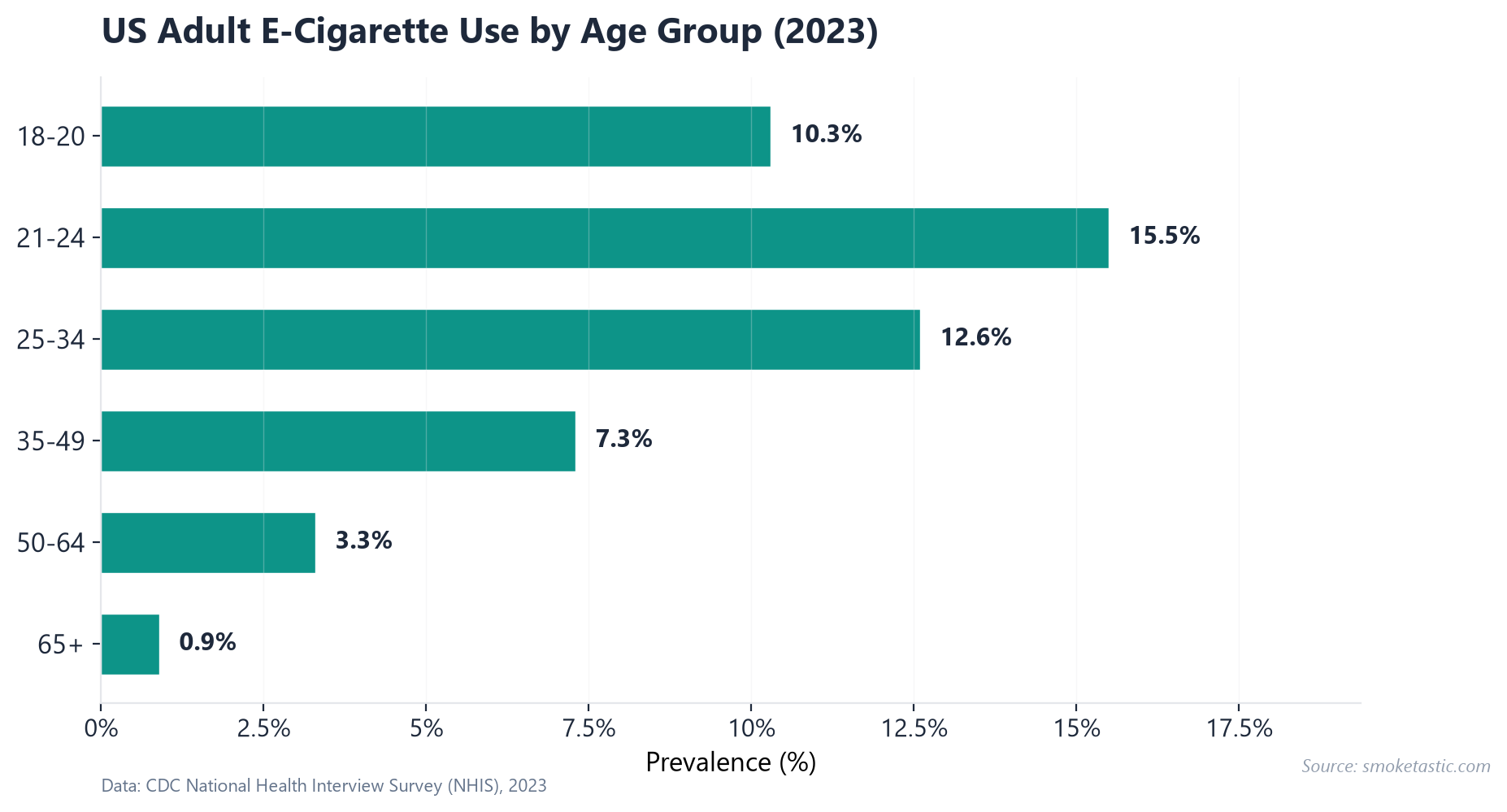
The United States has the most detailed vaping prevalence data in the world, thanks to the CDC’s annual National Health Interview Survey (NHIS). E-cigarette use among US adults has been rising since 2020 and reached its highest recorded level in 2023.
Prevalence by Age
- 6.5% of all US adults aged 18+ currently use e-cigarettes, up from 4.5% in 2019 and 3.7% in 2020. (CDC NHIS, 2023)
- 15.5% of adults aged 21-24 use e-cigarettes — the highest prevalence of any age group. (CDC NHIS, 2023)
- 12.6% of adults aged 25-34 use e-cigarettes. (CDC NHIS, 2023)
- 10.3% of adults aged 18-20 use e-cigarettes. (CDC NHIS, 2023)
- 7.3% of adults aged 35-49, 3.3% of 50-64, and 0.9% of 65+ use e-cigarettes. (CDC NHIS, 2023)
Prevalence by Sex and Race/Ethnicity
- 7.6% of US men vs 5.5% of US women currently use e-cigarettes. (CDC NHIS, 2023)
- 8.0% of adults identifying as other or multiple races vape — the highest of any racial/ethnic group, followed by White non-Hispanic (7.5%), Black non-Hispanic (5.7%), Hispanic (4.4%), and Asian non-Hispanic (3.4%). (CDC NHIS, 2023)
US Adult Vaping Trend (2019-2023)
| Year | Adult Prevalence | Trend |
|---|---|---|
| 2019 | 4.5% | Baseline |
| 2020 | 3.7% | ▼ COVID + EVALI effect |
| 2021 | 4.5% | ▲ Recovery |
| 2022 | 6.0% | ▲ Disposable boom |
| 2023 | 6.5% | ▲ New high |
2. US Youth Vaping Statistics
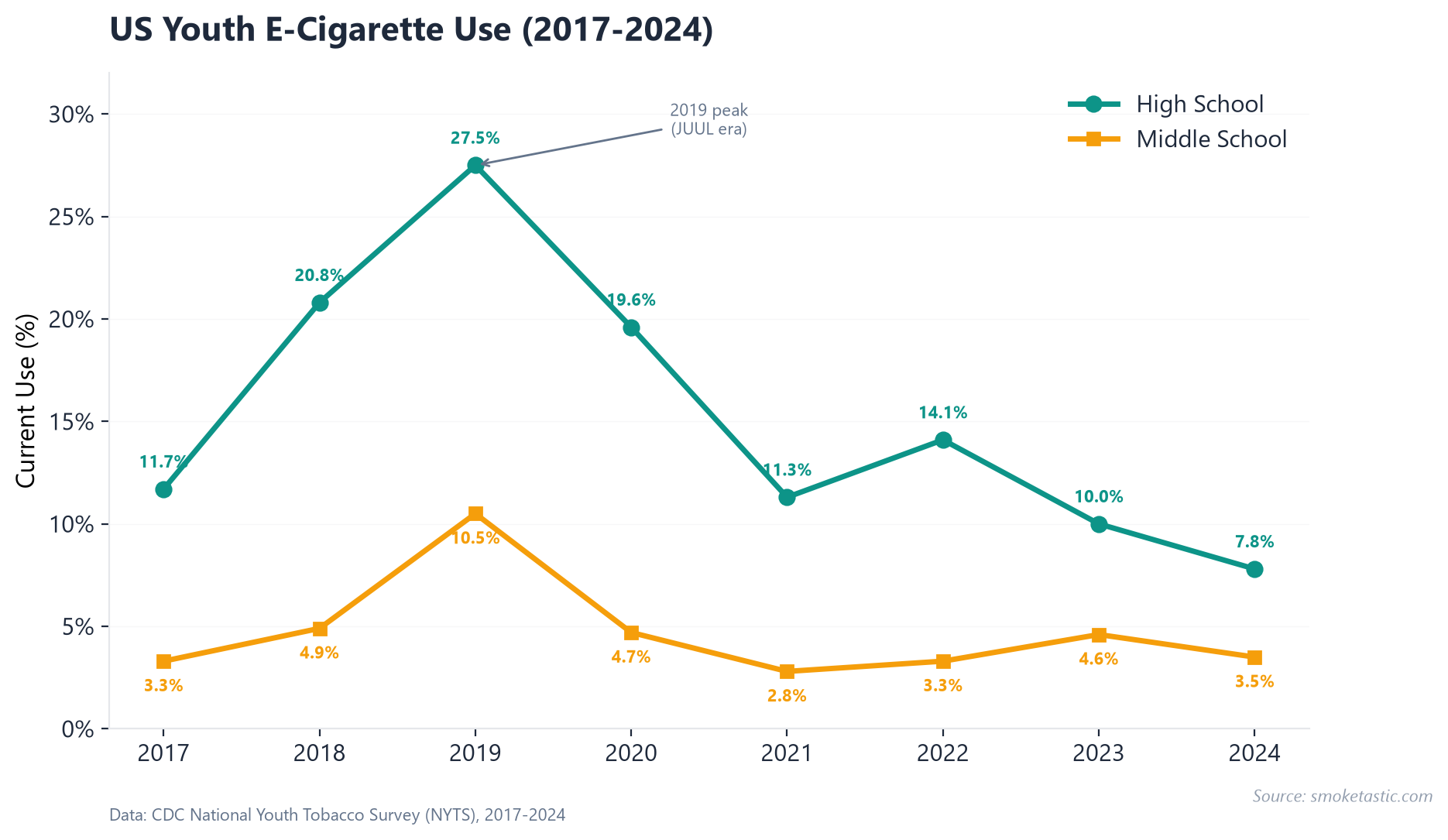
Youth e-cigarette use peaked in 2019 during the JUUL era, when over 5 million US students reported vaping. Since then, a combination of FDA enforcement, flavor restrictions, and EVALI awareness has driven a significant decline. In 2024, youth vaping dropped to its lowest level in a decade.
2024 Youth Usage
- 1.63 million US middle and high school students (5.9%) currently use e-cigarettes, down from 2.13 million (7.7%) in 2023. (CDC NYTS, 2024)
- 1.21 million high school students (7.8%) currently vape. (CDC NYTS, 2024)
- 410,000 middle school students (3.5%) currently vape. (CDC NYTS, 2024)
- 2024 youth vaping is approximately one-third of the 2019 peak, when over 5 million youth reported use. (CDC, 2024)
Device Types and Flavors (Youth)
- 55.6% of youth e-cigarette users use disposable devices (870,000 students). (CDC NYTS, 2024)
- 87.6% use a non-tobacco flavored product (1.43 million students). (CDC NYTS, 2024)
- 62.8% prefer fruit flavors (960,000 students). (CDC NYTS, 2024)
- 54.6% use “ice” or “iced” flavors (850,000 students). (CDC NYTS, 2024)
- 26.3% vape daily (430,000 students). (CDC NYTS, 2024)
Top Brands Among Youth (2024)
| Brand | Share of Youth Users | Est. Users |
|---|---|---|
| Elf Bar | 36.1% (down from 56.7% in 2023) | 560,000 |
| Breeze | 19.9% | 310,000 |
| Mr. Fog | 15.8% | 240,000 |
| Vuse | 13.7% | 210,000 |
| JUUL | 12.6% | 190,000 |
If you or someone you know is concerned about youth nicotine use, contact the SAMHSA National Helpline at 1-800-662-4357 (free, confidential, 24/7).
3. Global Vaping Market & Growth
The global vaping market has grown rapidly over the past decade, driven by disposable device proliferation and increasing adoption in emerging markets. North America accounts for over 43% of global revenue.
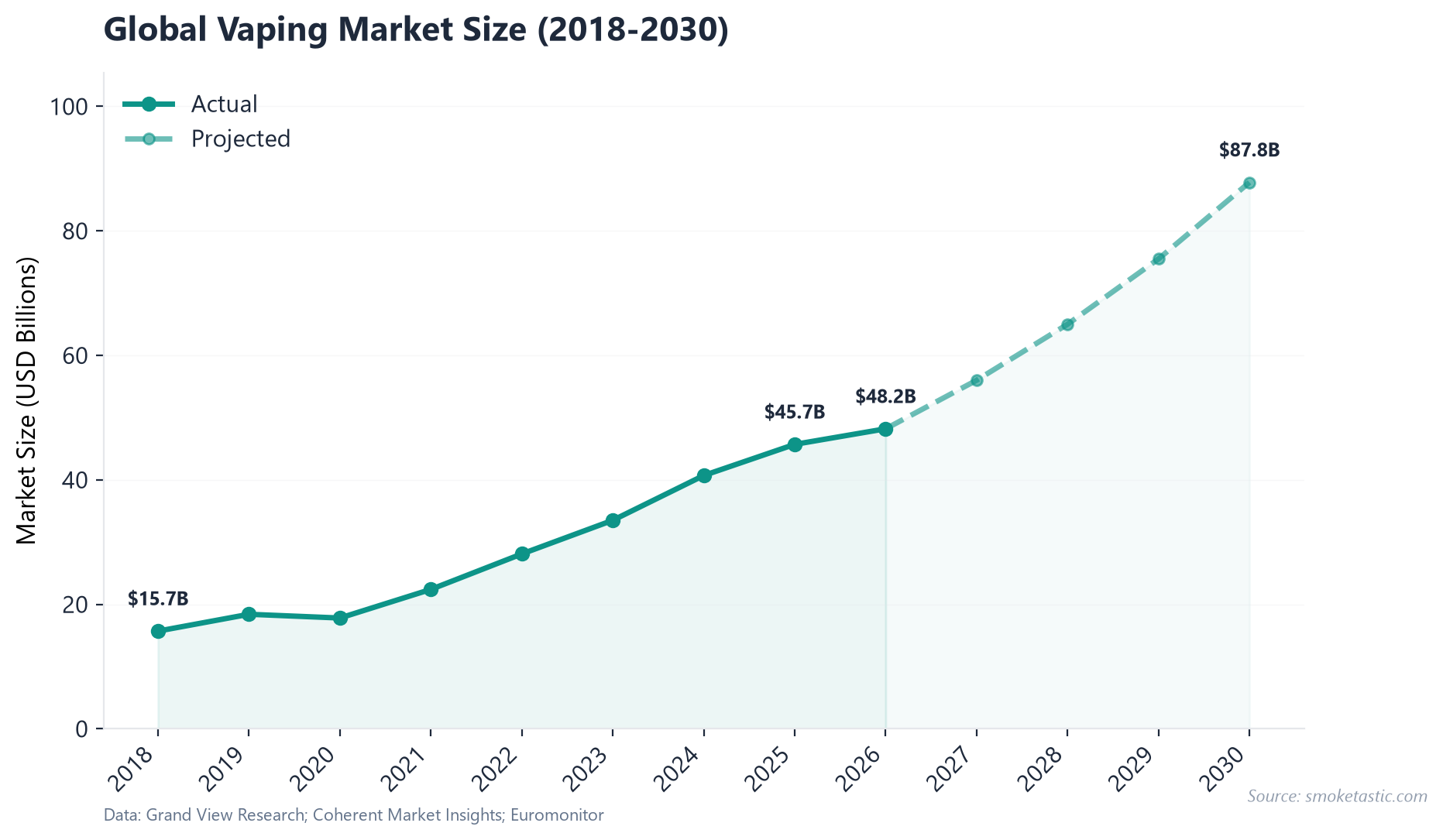
- $45.7 billion — global e-cigarette and vape market size in 2025. (Grand View Research, 2025)
- $48.2 billion — projected global market size for 2026. (Coherent Market Insights, 2026)
- 43.5% of the global vaping market is in North America — the dominant region. (Grand View Research, 2025)
- 26.9%-34.1% — projected CAGR for the global vaping market from 2026 to 2033. (Grand View Research / Coherent Market Insights)
4. Who Vapes Worldwide
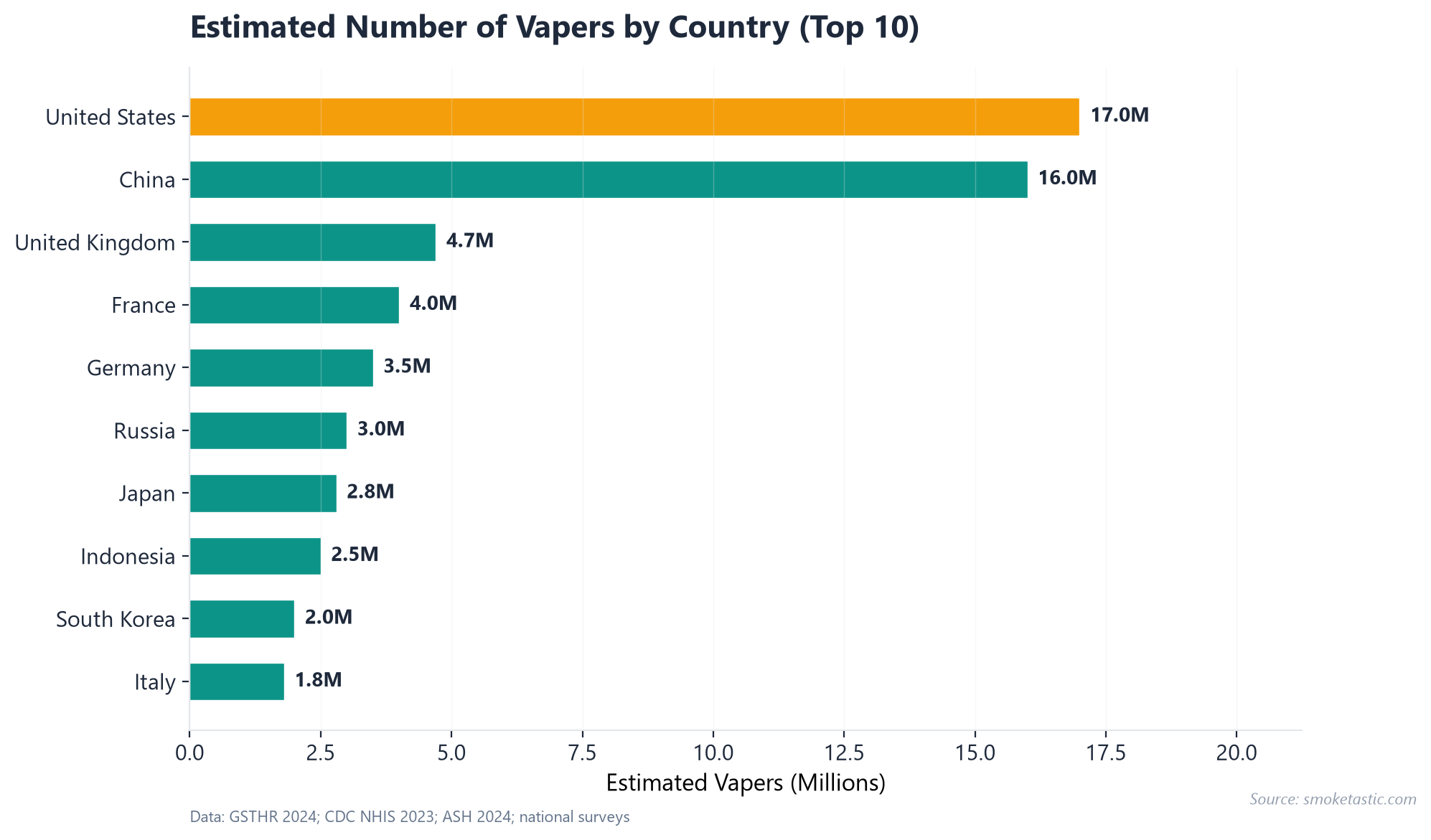
The global vaping population has grown from approximately 82 million in 2021 to an estimated 129 million adults in 2025. The United States leads in total vapers, followed by China and the United Kingdom.
- 129 million estimated adult nicotine vapers worldwide in 2025, up from 82 million in 2021. (GSTHR, 2025)
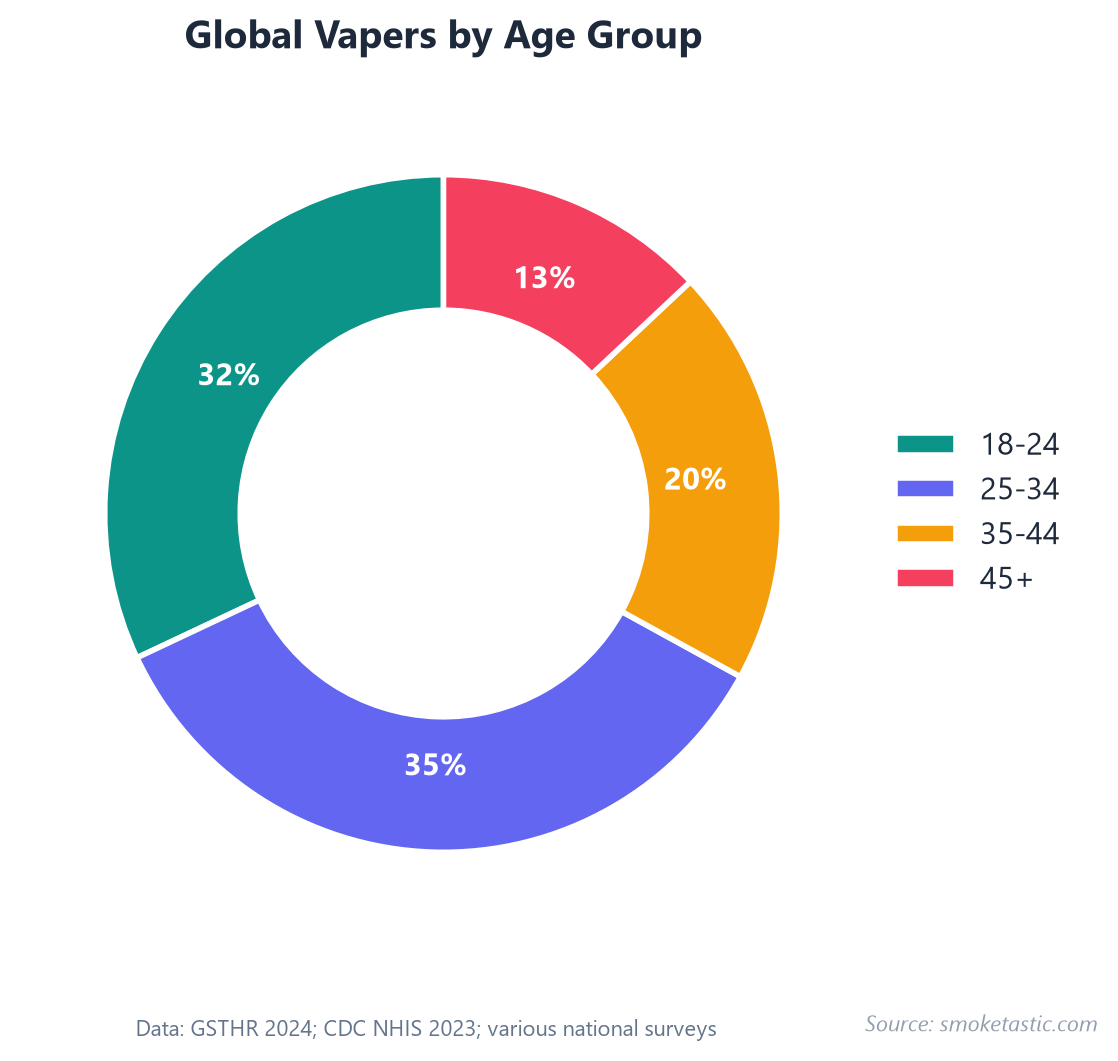
- 100+ million total vapers including approximately 86 million adults and 15 million adolescents aged 13-15, per the WHO’s first global estimate. (WHO, 2025)
- United States leads with approximately 17 million adult vapers, followed by China (~16M), United Kingdom (~4.7M), and France (~4M). (Various national surveys)
5. Health & Harm Reduction Statistics
This section presents findings from published research. It is not medical advice. The long-term health effects of e-cigarettes remain under investigation.
EVALI Outbreak (2019-2020)
- 2,807 EVALI hospitalizations reported to CDC from all 50 states, DC, Puerto Rico, and USVI (final count as of Feb 18, 2020). (CDC, 2020)
- 68 deaths confirmed across 29 states and DC. (CDC, 2020)
- Cause identified: vitamin E acetate used as a thickening agent in illicit THC cartridges — not commercial nicotine e-cigarettes. (CDC MMWR, 2020)
- Median patient age: 24 years (range: 13-85). (CDC MMWR, 2020)
Relative Harm
- The National Academies of Sciences, Engineering, and Medicine (NASEM) concluded in 2018 that e-cigarettes are likely less harmful than combustible cigarettes in the short term, though long-term health effects remain unknown. (NASEM, 2018)
- Public Health England (now OHID) estimated vaping is 95% less harmful than smoking, first published in 2015 and reaffirmed in subsequent evidence reviews through 2022. (PHE/OHID, 2022)
Smoking Cessation Effectiveness
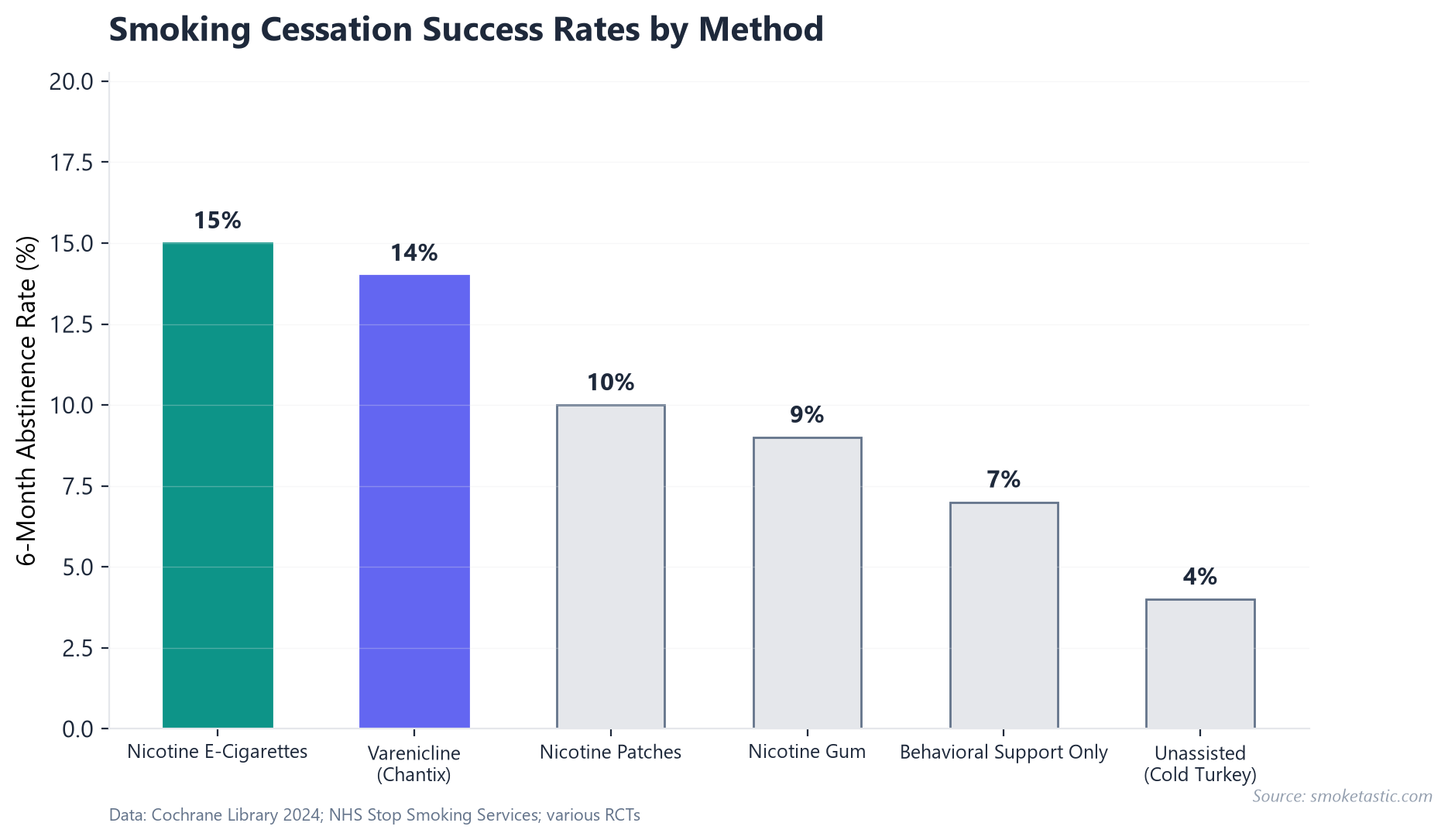
- A 2024 Cochrane review (88 studies, 27,235 participants) found nicotine e-cigarettes increase smoking cessation rates by 63% compared to nicotine replacement therapy (risk ratio 1.63). (Cochrane, 2024)
- Nicotine e-cigarettes were found to be as effective as varenicline (Chantix) for smoking cessation at 26 weeks. (Cochrane, 2024)
6. Vaping vs Smoking Comparison
Vaping is significantly cheaper than cigarette smoking in the US, though costs vary widely by state (due to cigarette taxes) and by device type.
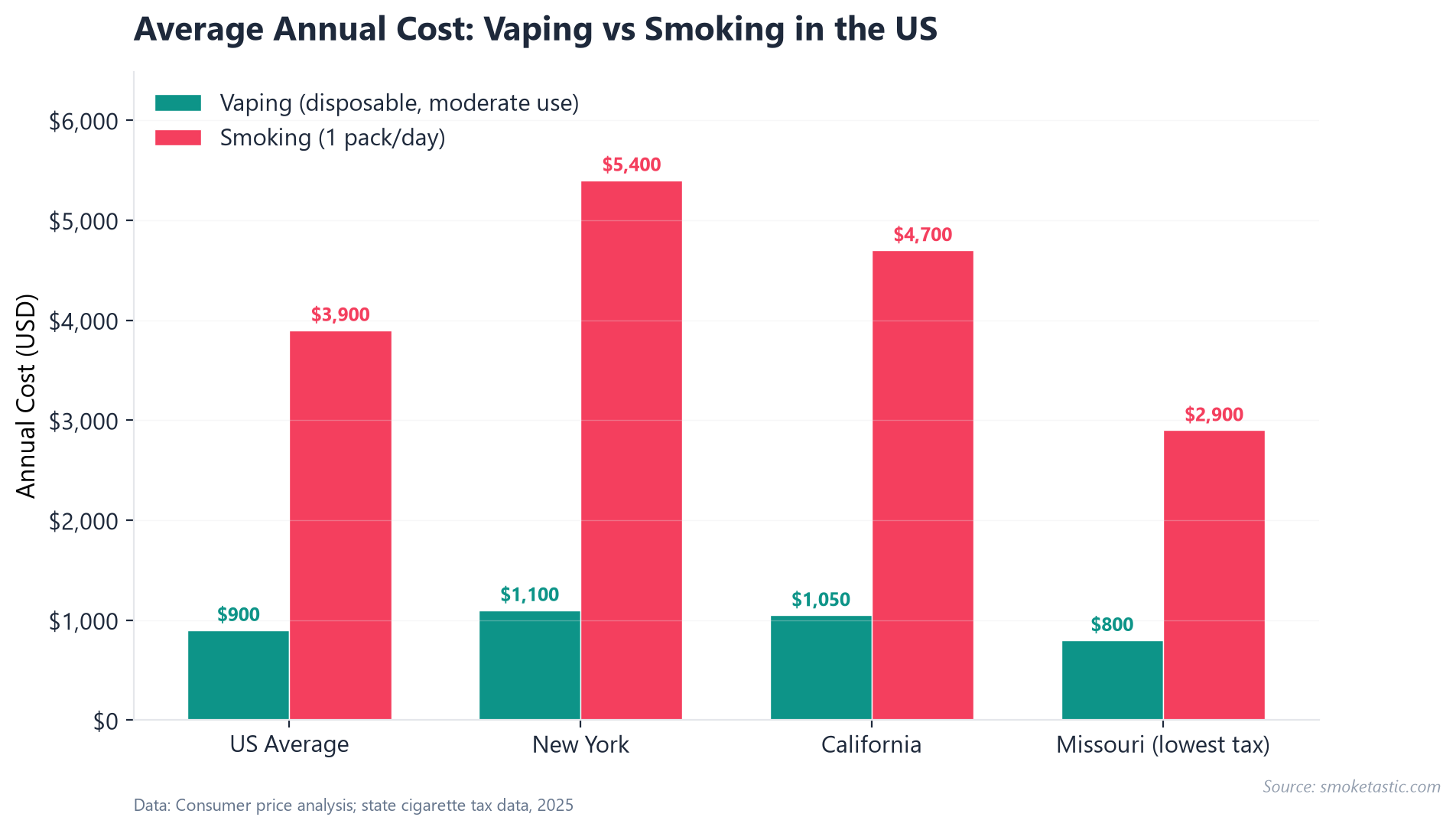
- ~$900/year — average annual cost of vaping for a moderate disposable user (5 days/week) in the US. (Money Digest, 2025)
- $3,300-$4,600/year — average annual cost of smoking (1 pack/day) in the US, depending on state. (State price data, 2025)
- $15 billion/year — estimated healthcare cost attributable to e-cigarette use in the US. (UCSF, 2022)
- ~$82/month on e-cigarettes and ~$119/month on cigarettes — average spending among dual users. (NIH/PMC, 2024)
7. US Regulatory Landscape
The FDA regulates e-cigarettes as tobacco products in the United States. Federal law sets the minimum purchase age at 21. Individual states add their own restrictions, particularly on flavored products.
Federal Regulations
- Age 21+ — federal minimum purchase age for all tobacco and e-cigarette products (Tobacco 21 law, signed December 2019). (FDA)
- PMTA required — all e-cigarette products must submit a Premarket Tobacco Product Application to the FDA. As of 2026, only a small number of products (primarily VUSE) have received marketing authorization.
State-Level Flavor Restrictions (2026)
| State | Restriction Type | Flavors Allowed | Effective |
|---|---|---|---|
| California | Comprehensive ban | Tobacco only | Jan 2025 |
| Massachusetts | Comprehensive ban | Tobacco only | Jun 2020 |
| New York | Comprehensive ban | Tobacco only (incl. menthol banned) | May 2020 |
| New Jersey | Comprehensive ban | Tobacco only | Apr 2020 |
| Rhode Island | Comprehensive ban | Tobacco only | Jan 2025 |
| Oregon | Comprehensive ban | Tobacco only | 2024 |
| Washington | Comprehensive ban | Tobacco only | 2024 |
| Utah | Partial ban | Tobacco and menthol | Jan 2025 |
| Maryland | Partial restriction | Age-restricted venues only | 2024 |
| DC | Comprehensive ban | Tobacco only | 2023 |
| Wisconsin | Directory system | Registered products only | 2024 |
| North Carolina | Directory system | Registered products only | 2024 |
| Florida | Directory system | Registered products only | 2025 |
International Regulations
- 46 countries have entirely banned e-cigarette sales, including Brazil, India, Thailand, Singapore, and others. (GGTC, 2025)
- Belgium, France, and the UK banned disposable vapes specifically (Belgium Jan 2025, France Feb 2025, UK Jun 2025).
- Australia requires a prescription for e-cigarettes; importation outside pharmacies is illegal.
- The EU Tobacco Products Directive caps nicotine at 20mg/mL and tank capacity at 2mL.
8. Economic & Industry Statistics
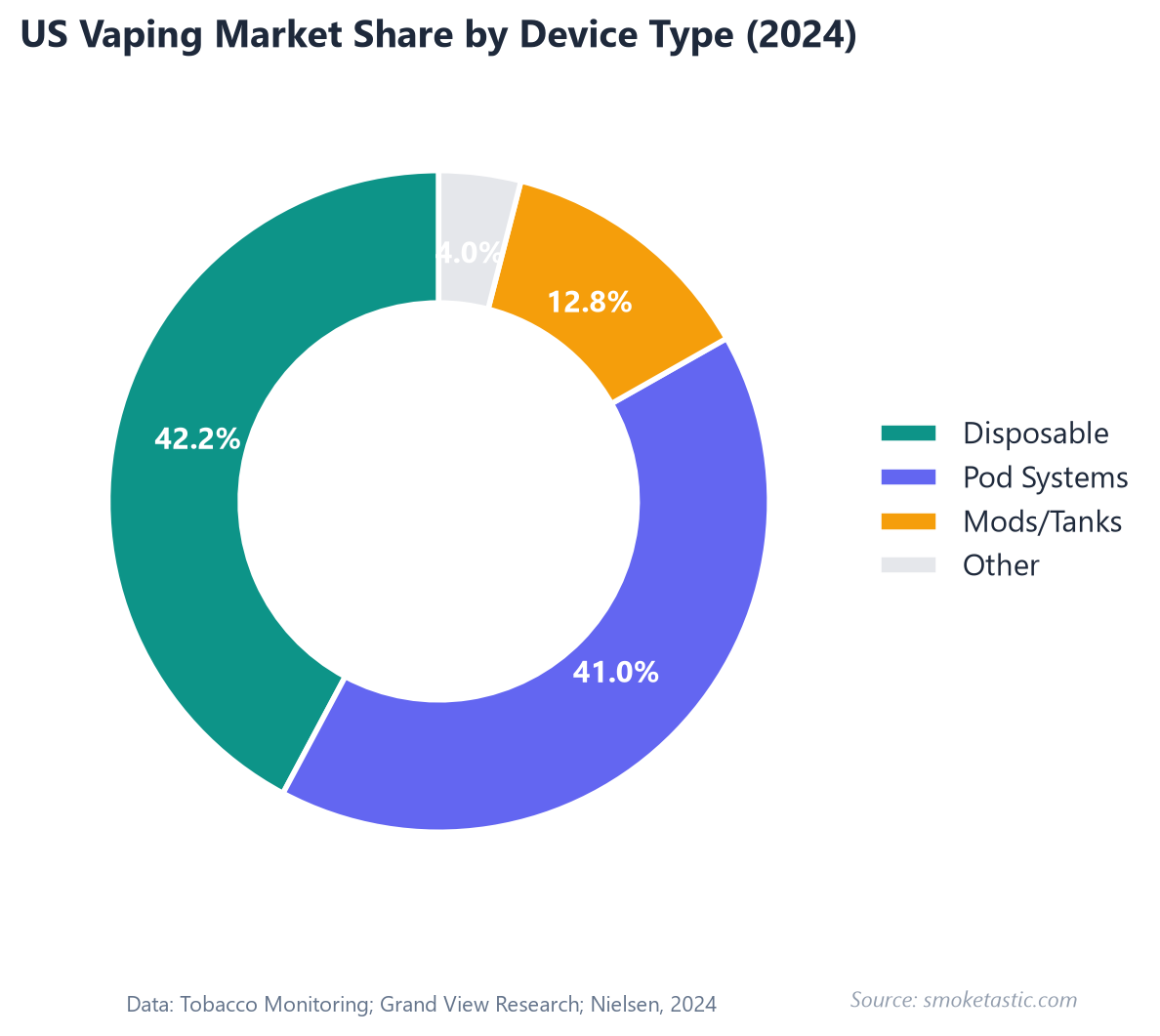
The US vaping industry is a significant employer and economic contributor. Disposable vapes have surged to become the dominant product category by dollar sales, overtaking pod systems.
- 87,581 jobs in the US vaping industry. (Vapor Technology Association, 2019)
- $3.28 billion in wages generated by the US vaping industry. (VTA, 2019)
- $9.15 billion in direct economic activity generated by US vape businesses. (VTA, 2019)
- 42.2% — US dollar market share held by disposable devices in 2024, up from 10.9%. (Tobacco Monitoring, 2024)
- 41% — US market share held by pod vape systems. (Grand View Research, 2024)
9. Environmental & Sustainability
Disposable vapes have created a growing environmental and waste management problem. Each device contains a lithium-ion battery, plastic, nicotine residue, and electronic components that cannot be recycled through standard waste streams.
- ~500,000 disposable vapes are discarded per day in the US (5.7 per second in 2023, up from 4.5/sec in 2022). (U.S. PIRG Education Fund, 2023)
- 30 tons of lithium are discarded annually from disposable vapes in the US — enough to produce 3,350 electric vehicle batteries. (U.S. PIRG, 2023)
- 150% increase in vapes collected during beach cleanups from 2021 to 2024. (Surfrider Foundation, 2024)
- 268+ lithium-ion battery fires suppressed in waste facilities in 2024, with 500+ projected for 2025. (International Fire & Safety Journal, 2024)
- Discarded vape pens contain lead and mercury that can leach into soil — devices are classified as both e-waste and hazardous waste. (U.S. PIRG, 2023)
10. Methodology & Sources
How Statistics Were Selected
Every statistic on this page comes from one of the following source types, listed in priority order:
- US government agencies: CDC, FDA, NIH/NCI, SAMHSA, US Surgeon General, EPA
- US national surveys: NYTS, NHIS, BRFSS, PATH Study
- US research bodies: NASEM, Truth Initiative
- International government agencies: WHO, PHE/OHID (UK), European Commission
- Peer-reviewed journals: NEJM, JAMA, Lancet, BMJ, Tobacco Control, Nicotine & Tobacco Research
- Established research bodies: ASH (UK), Cochrane Reviews, GSTHR
- Market research firms: Euromonitor, Grand View Research (for market/industry data only)
What’s Excluded
- Industry-funded studies without independent verification
- Social media polls or informal surveys
- Self-published blogs or forums
- Smoketastic’s own editorial opinions
- Pre-print studies not yet peer-reviewed (unless from a major institution and clearly labeled)
Source List
- CDC NCHS Data Brief No. 524 — Electronic Cigarette Use Among Adults: United States, 2019-2023
- CDC MMWR Vol. 73/No. 35 — E-Cigarette and Nicotine Pouch Use Among Middle and High School Students, 2024
- CDC MMWR Vol. 73/No. 41 — Tobacco Product Use Among Middle and High School Students, 2024
- CDC — EVALI Outbreak Investigation (final update Feb 2020)
- CDC MMWR Vol. 69/No. 3 — Characteristics of a Nationwide Outbreak of E-cigarette Use-Associated Lung Injuries
- NASEM — Public Health Consequences of E-Cigarettes (2018)
- Cochrane Library — Electronic Cigarettes for Smoking Cessation (2024)
- PHE/OHID — E-cigarettes and Heated Tobacco Products Evidence Review
- Grand View Research — E-cigarette and Vape Market Size, Share & Trends Report
- Coherent Market Insights — E-cigarette and Vape Market Size and Forecast
- GSTHR — Estimated Global Number of Vapers (2024/2025)
- U.S. PIRG Education Fund — Vape Waste: The Environmental Harms of Disposable Vapes
- Vapor Technology Association — Vaping Impact on the Economy
- Tobacco Monitoring — E-Cigarette Sales Data & Trends in the United States
- UCSF — E-Cigarette Use Costs U.S. $15B Per Year
- GGTC — E-Cigarette Ban & Regulation Fact Sheet (2025)
This page is reviewed annually. Last updated: June 2026.
11. How to Cite & Embed Our Charts
Cite This Page
APA: Smoketastic. (2026). Vaping statistics & facts (2026). https://smoketastic.com/vaping-statistics/
MLA: “Vaping Statistics & Facts (2026).” Smoketastic, 2026, smoketastic.com/vaping-statistics/.
Chicago: Smoketastic. “Vaping Statistics & Facts (2026).” Smoketastic. Accessed [date]. https://smoketastic.com/vaping-statistics/.
Embed Our Charts
All charts on this page are free to use with attribution. Copy the embed code below any chart and paste it into your article or report. Please do not modify the charts or remove the attribution link.
C1: US Adult E-Cigarette Use by Age Group
<figure>
  <img src="https://smoketastic.com/wp-content/uploads/stats/c1-us-adult-vaping-by-age.png"
       alt="US adult e-cigarette use by age group 2023"
       width="1200" height="600" loading="lazy">
  <figcaption>Source: CDC NHIS, 2023. Chart by
    <a href="https://smoketastic.com/vaping-statistics/">Smoketastic</a>.
    Licensed for reuse with attribution.</figcaption>
</figure>
C2: US Youth E-Cigarette Use 2017-2024
<figure>
  <img src="https://smoketastic.com/wp-content/uploads/stats/c2-us-youth-vaping-trend.png"
       alt="US youth e-cigarette use trend 2017-2024"
       width="1200" height="600" loading="lazy">
  <figcaption>Source: CDC NYTS, 2017-2024. Chart by
    <a href="https://smoketastic.com/vaping-statistics/">Smoketastic</a>.
    Licensed for reuse with attribution.</figcaption>
</figure>
C3: Global Vaping Market Size
<figure>
  <img src="https://smoketastic.com/wp-content/uploads/stats/c3-global-market-size.png"
       alt="Global vaping market size 2018-2030"
       width="1200" height="600" loading="lazy">
  <figcaption>Source: Grand View Research; Coherent Market Insights; Euromonitor. Chart by
    <a href="https://smoketastic.com/vaping-statistics/">Smoketastic</a>.
    Licensed for reuse with attribution.</figcaption>
</figure>
C4: Vapers by Country
<figure>
  <img src="https://smoketastic.com/wp-content/uploads/stats/c4-vapers-by-country.png"
       alt="Estimated number of vapers by country top 10"
       width="1200" height="700" loading="lazy">
  <figcaption>Source: GSTHR 2024; CDC; ASH; national surveys. Chart by
    <a href="https://smoketastic.com/vaping-statistics/">Smoketastic</a>.
    Licensed for reuse with attribution.</figcaption>
</figure>
C5: Global Vapers by Age Group
<figure>
  <img src="https://smoketastic.com/wp-content/uploads/stats/c5-vapers-by-age.png"
       alt="Global vapers by age group donut chart"
       width="800" height="600" loading="lazy">
  <figcaption>Source: GSTHR 2024; various national surveys. Chart by
    <a href="https://smoketastic.com/vaping-statistics/">Smoketastic</a>.
    Licensed for reuse with attribution.</figcaption>
</figure>
C6: Smoking Cessation Success Rates
<figure>
  <img src="https://smoketastic.com/wp-content/uploads/stats/c6-cessation-success-rates.png"
       alt="Smoking cessation success rates by method"
       width="1200" height="600" loading="lazy">
  <figcaption>Source: Cochrane Library 2024; various RCTs. Chart by
    <a href="https://smoketastic.com/vaping-statistics/">Smoketastic</a>.
    Licensed for reuse with attribution.</figcaption>
</figure>
C7: Vaping vs Smoking Cost
<figure>
  <img src="https://smoketastic.com/wp-content/uploads/stats/c7-vaping-vs-smoking-cost.png"
       alt="Average annual cost vaping vs smoking in the US"
       width="1000" height="600" loading="lazy">
  <figcaption>Source: Consumer price analysis; state tax data, 2025. Chart by
    <a href="https://smoketastic.com/vaping-statistics/">Smoketastic</a>.
    Licensed for reuse with attribution.</figcaption>
</figure>
C9: US Market Share by Device Type
<figure>
  <img src="https://smoketastic.com/wp-content/uploads/stats/c9-us-market-share-device-type.png"
       alt="US vaping market share by device type 2024"
       width="800" height="600" loading="lazy">
  <figcaption>Source: Tobacco Monitoring; Grand View Research; Nielsen, 2024. Chart by
    <a href="https://smoketastic.com/vaping-statistics/">Smoketastic</a>.
    Licensed for reuse with attribution.</figcaption>
</figure>
Terms of Use
All charts and statistics on this page are free to use with attribution. Please link back to https://smoketastic.com/vaping-statistics/. Charts may not be modified or have attribution removed.
Media & research inquiries: For custom data requests or media quotes, contact contact@smoketastic.com.
12. Frequently Asked Questions
How many people vape in the US?
Approximately 17 million US adults (6.5% of the adult population) currently use e-cigarettes, according to the 2023 CDC National Health Interview Survey. Among youth, 1.63 million middle and high school students currently vape (2024 NYTS data).
How many people vape worldwide?
An estimated 129 million adults vape worldwide as of 2025, according to the Global State of Tobacco Harm Reduction. The WHO estimates the total at over 100 million when including approximately 15 million adolescents aged 13-15.
What percentage of US teens vape?
In 2024, 5.9% of US middle and high school students reported current e-cigarette use (1.63 million students). This is down significantly from the 2019 peak, when over 5 million youth (27.5% of high schoolers) reported vaping. E-cigarettes remain the most commonly used tobacco product among US youth.
Is vaping safer than smoking?
Public Health England (now OHID) estimated in 2015 that vaping is 95% less harmful than smoking, a figure reaffirmed in subsequent reviews. The US National Academies of Sciences (NASEM) concluded in 2018 that e-cigarettes are likely less harmful than combustible cigarettes in the short term, though long-term health effects remain unknown. This page presents published research findings and is not medical advice.
How much does vaping cost per year in the US?
A moderate disposable vape user in the US spends approximately $900 per year. This compares to $3,300-$4,600 per year for a pack-a-day cigarette smoker, depending on the state. Higher-end pod or mod setups with regular e-liquid purchases can cost $1,200-$2,000 annually.
Which US states have banned flavored vapes?
As of 2026, at least 8 states have comprehensive flavored vape bans: California, Massachusetts, New York, New Jersey, Rhode Island, Oregon, Washington, and Utah. Several others (Wisconsin, North Carolina, Florida) use product directory systems that effectively restrict most disposable vapes. Washington DC also has a comprehensive flavor ban.
How big is the US vaping market?
The global e-cigarette and vaping market was valued at approximately $45.7 billion in 2025, with North America accounting for 43.5% of global revenue. The US is the world’s largest single market. The industry employs over 87,000 people in the US and generates $9.15 billion in direct economic activity.
What is the most popular type of vape in America?
Disposable vapes and pod systems dominate the US market, each holding approximately 41-42% of dollar sales in 2024. Among youth, 55.6% of e-cigarette users use disposable devices. Mods and tank systems account for the remaining ~13% of the market.
Smoketastic is an independent vape review site. We are not funded by tobacco or vaping companies. Statistics on this page are sourced from the organizations cited and do not represent Smoketastic’s own research.