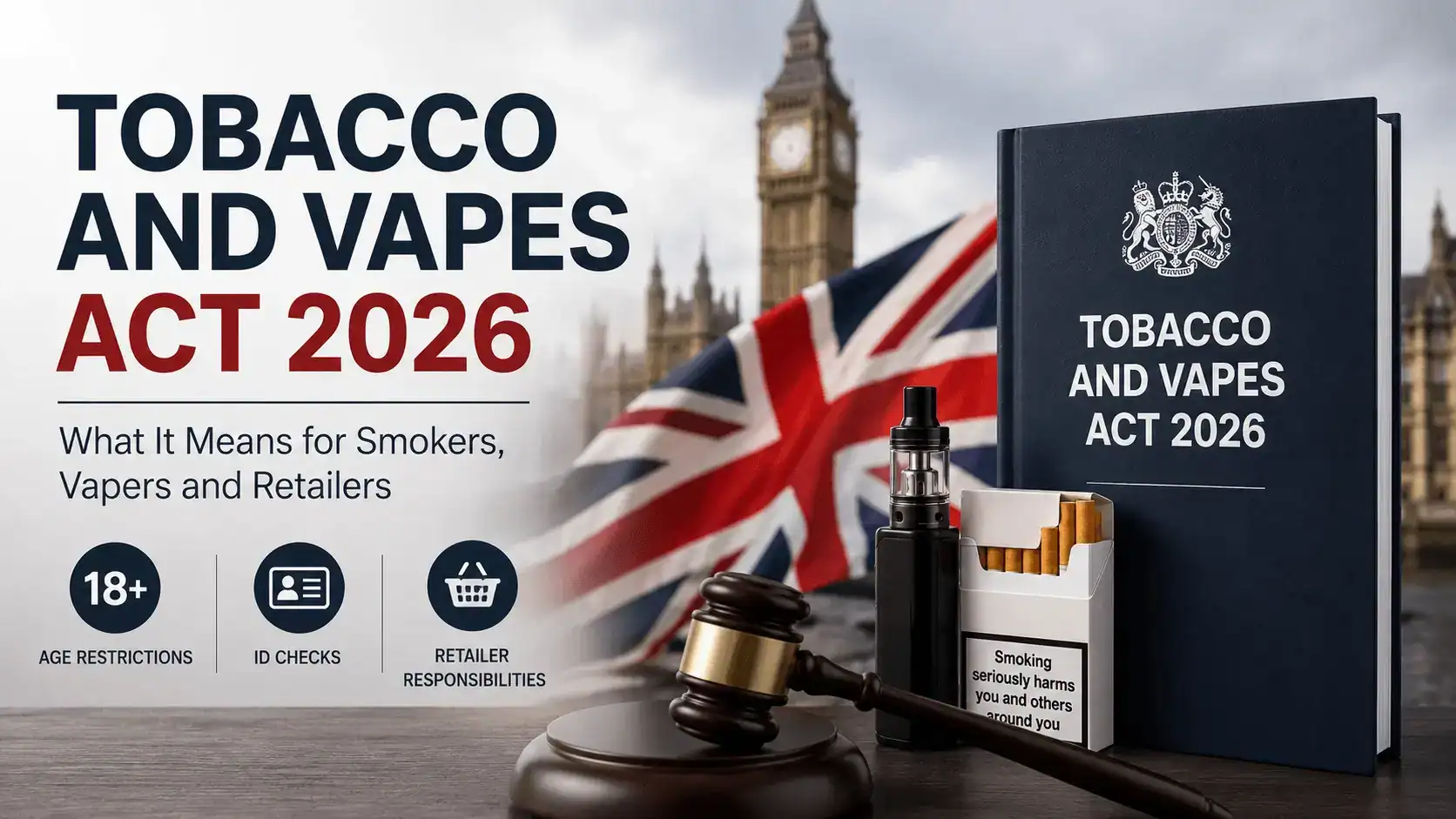
The UK Tobacco and Vapes Act 2026: What It Actually Means for Vapers
Key Takeaways
- The Tobacco and Vapes Act 2026 received Royal Assent in the UK and introduces sweeping restrictions on flavored vapes, retail licensing, and designated vape-free public spaces. 1
- Most flavored vapes will be banned outright, with menthol occupying a contested exemption zone — the final rules on this are still being clarified through secondary legislation. 2
- Retailers face significant new licensing requirements, display bans, and financial transition costs that could permanently alter the UK vape market. 1
- Enforcement sits with local Trading Standards authorities, and fines for violations can reach into the thousands — with repeat offenders facing criminal prosecution. 1
- Cross-border and online purchasing creates real enforcement gaps that the Act doesn’t fully close, particularly for Northern Ireland and EU-based retailers. 2
Read on for the full breakdown.
What Is the Tobacco and Vapes Act 2026? (And Why Should You Care?)
The Flavored Vape Ban: Which Flavors Are You Losing?
The Retail Landscape Changes: What Happens to Vape Shops?
Penalties, Fines, and Enforcement—The Teeth Behind the Act
Heated Tobacco Products: The Overlooked Regulation
Vape-Free and Smoke-Free Places: Where You Can’t Vape Anymore
The Cross-Border Loophole: Online, Northern Ireland, and EU Imports
Who Gets Exempted? (It’s Narrower Than You Think)
Timeline and Phase-In: When Does Each Rule Actually Take Effect?
What This Means for American Vapers (And Why You Should Be Watching)
The Reality Check: What Vapers Actually Need to Do Right Now
The UK just passed one of the most aggressive vaping crackdowns in the Western world — and most American vapers haven’t heard about it yet. That’s a problem. Because if history tells us anything about tobacco and nicotine regulation, it’s that what Parliament does today tends to show up in state legislatures across the US within three to five years. The tobacco and vapes act 2026 isn’t just a British story. It’s a preview.
This article breaks down exactly what the Act does, which provisions actually have enforcement teeth, and where the regulatory gaps are wide enough to drive a freight truck through. If you’re a vaper tracking global policy shifts, or a US retailer watching which way the wind is blowing, you need to understand this legislation clearly — not the sanitized press-release version.
What Is the Tobacco and Vapes Act 2026? (And Why Should You Care?)

The Basics — What the Government Actually Passed
The Tobacco and Vapes Act 2026 is a UK statute that received Royal Assent in 2026, consolidating and dramatically expanding the country’s existing tobacco and nicotine product regulations. 1 It amends prior legislation, introduces entirely new categories of restriction, and — critically — extends regulatory reach to vaping products in ways the UK had never previously codified into primary law. 2
The Act covers England, Wales, Scotland, and Northern Ireland, though with important jurisdictional nuances that create real enforcement inconsistencies (more on that later). 1 At its core, it does four things: bans most flavored vaping products, tightens retail licensing requirements, designates new vape-free public spaces, and creates a penalty framework for non-compliance. Simple in concept. Brutally complicated in execution.
Why Wes Streeting’s Health Department Pushed This Through
Health Secretary Wes Streeting has been the Act’s most visible champion, framing it explicitly as a public health intervention aimed at reducing youth vaping rates. 6 The government’s position — and Streeting has said this directly — is that the vaping industry deliberately engineered flavored products and disposable devices to appeal to under-18s.
That’s a contested claim. The vaping industry argues, with some statistical support, that flavored vapes are primarily used by adult smokers switching away from cigarettes. Action on Smoking and Health (ASH) has long noted that vaping serves a genuine harm-reduction purpose for adult smokers. 5 But Streeting’s department chose to prioritize youth access concerns, and the legislation reflects that prioritization decisively.
Honestly? The government’s case is stronger on youth access than it is on flavors specifically. Banning flavors because teenagers like them also removes what many adult ex-smokers say is a critical part of staying off cigarettes. That’s a real tradeoff, and the Act doesn’t acknowledge it honestly.
How This Differs From Previous Tobacco Bills
Prior UK tobacco legislation — the Health Act 2009, the Children and Families Act 2014, and the Tobacco and Related Products Regulations 2016 — addressed display bans, standardized packaging, and product safety standards. None went as far as outright flavor prohibition or created the kind of retailer licensing structure this Act introduces. 6 This legislation is categorically different in scope and ambition.
The Flavored Vape Ban: Which Flavors Are You Losing?
Exactly Which Flavors Get Banned (and When)
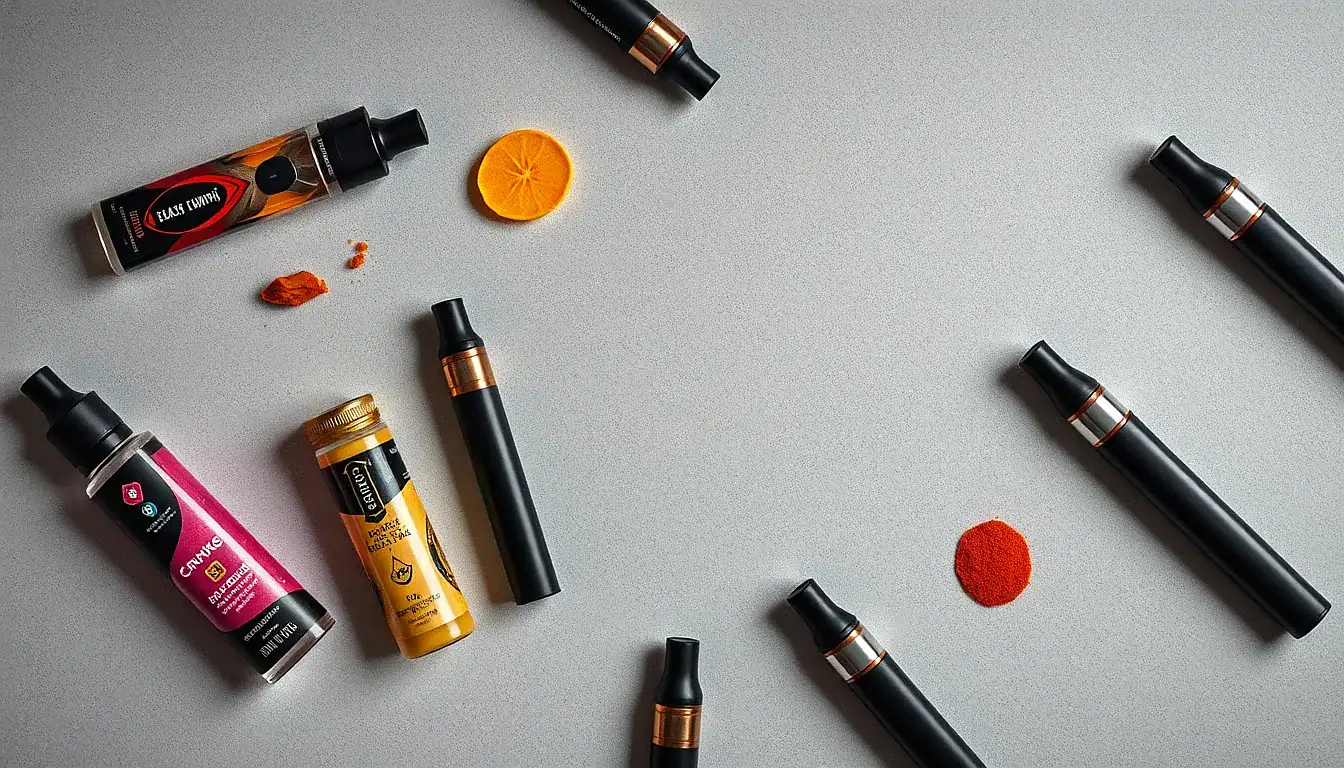
The Act empowers the Secretary of State to set permitted flavor lists through secondary legislation — meaning the specific banned flavors won’t all be spelled out in the primary statute itself. 1 What the Act establishes is the legal architecture: vaping products can only be sold in flavors that appear on an approved list. If a flavor isn’t on the list, it’s banned by default. That’s a significant inversion of the previous approach, where products were permitted unless specifically prohibited.
In practical terms, the industry expects the approved list to be narrow. Tobacco flavor is near-certain to remain. Standard menthol is in a contested middle ground. Everything else — fruit, dessert, candy, beverage-inspired flavors, ice variants — faces near-certain prohibition once the secondary legislation is finalized. That covers the vast majority of what currently sells in the UK vape market.
The timing matters. Retailers won’t face overnight removal of current stock — the Act includes transition provisions — but new stock orders after implementation triggers will need to comply. 2 Watch for secondary legislation announcements from the Department of Health and Social Care, because those will set the actual clock.
Menthol Vapes: The Exemption Explained
Menthol sits in a genuinely ambiguous position under the Act. The primary legislation doesn’t explicitly protect it, but government consultation documents and industry guidance have suggested menthol may survive the flavor restrictions — at least initially. 2 This mirrors the approach some US jurisdictions have taken. Lincolnwood, Illinois, for example, carved out menthol from its flavored tobacco restrictions, a decision that reflects ongoing political sensitivity around menthol bans in communities where menthol tobacco has deep market penetration. 7
The UK situation is less about political sensitivity and more about the harm-reduction argument. Menthol, the government seems to accept, serves a distinct population of adult smokers transitioning away from menthol cigarettes. But — and this matters — “menthol” as a descriptor covers an enormous range of products, including heavily iced vapes that bear little resemblance to traditional menthol. The secondary legislation will need to define menthol precisely to prevent manufacturers from gaming the exemption with cooling agents.
Other Flavors That Might Surprise You — Cooling Agents and Exemptions
Cooling agents like WS-23 and WS-3 are synthetic compounds that produce a cooling sensation without technically being menthol. They’re widely used in vape products marketed as “ice” variants. Under the Act’s framework, these almost certainly won’t qualify for a menthol exemption — but the enforcement challenge is real. Lab testing to distinguish menthol from synthetic cooling compounds requires resources that most local Trading Standards teams simply don’t have at scale.
The Retail Landscape Changes: What Happens to Vape Shops?
New Licensing Requirements and How Much They’ll Cost
The Act introduces a mandatory licensing regime for vape product retailers — a significant structural change from the previous registration-based approach. 1 Under the new framework, retailers must hold a valid license to sell vaping products, and licensing applications involve fees, premises inspections, and ongoing compliance requirements.
Specific fee structures are subject to secondary legislation and local authority implementation, so precise figures aren’t yet locked in across the board. 2 What is clear is that small independent vape retailers — which represent a substantial portion of the UK market — will bear these costs disproportionately compared to large chains with dedicated compliance infrastructure. A single-location vape shop operator faces the same licensing burden as a national chain, but without the economies of scale to absorb it.
| Retailer Type | Estimated Compliance Burden | Licensing Complexity | Revenue Impact from Flavor Ban |
|---|---|---|---|
| Independent Vape Shop | High — limited staff, single premises | High — no dedicated compliance team | Severe — flavor variety is primary differentiator |
| Convenience / Corner Store | Medium — vapes are secondary product line | Medium — existing licensing frameworks may adapt | Moderate — disposable flavored vapes are high-margin items |
| National Chain (e.g., pharmacy) | Low — compliance infrastructure already exists | Low — legal teams handle multi-site licensing | Low-Moderate — tobacco products offset vape revenue loss |
| Online Retailer (UK-based) | Medium — delivery age verification required | High — new digital verification mandates | Severe — online market heavily skewed toward flavored products |
Display Bans and Age-Verification Tech Mandates
The Act tightens existing point-of-sale restrictions on vaping products, effectively extending display ban logic from tobacco cigarettes to vapes. 1 Retailers can no longer display vaping products openly — they must be stored out of sight and produced only upon request. That’s already standard for tobacco in the UK, but it’s new territory for vape retailers who’ve built entire shop concepts around visible product displays.
Age verification requirements also become more stringent. The Act doesn’t mandate a specific technology, but the direction of travel is toward digital ID verification — particularly for online sales. 2 Physical retailers using “Challenge 25” policies will find those policies now carry formal legal weight rather than just best-practice status.
The Real Financial Hit to Small Retailers — Transition Costs and Lost Revenue
Here’s where the rubber meets the road. A small vape retailer transitioning to compliance faces costs across several categories simultaneously: licensing application fees, premises modifications to comply with display bans, staff training on new age-verification procedures, inventory write-downs on non-compliant flavored stock, and the permanent revenue loss from banned product categories.
No official economic impact assessment for small retailers has been published by the government at the level of granularity the industry needs. That’s a genuine policy failure. The government commissioned no detailed small-business impact analysis equivalent to what US regulators typically produce under the Regulatory Flexibility Act. Vapers and retailers are, frankly, being asked to absorb enormous disruption without a clear cost-benefit accounting from the people making the rules.
✓ Pros
- Stricter age verification reduces youth access to vaping products
- Licensing creates a quality-control floor — unregistered sellers face criminal penalties
- Display bans reduce impulse purchases by minors in mixed-retail environments
✗ Cons
- Licensing fees and compliance costs fall hardest on small independent retailers
- Flavor bans eliminate high-margin products that adult ex-smokers rely on
- Display bans increase operational friction with no proven youth-access benefit in tobacco precedents
- Transition timeline may be too compressed for small businesses to restructure inventory
Penalties, Fines, and Enforcement—The Teeth Behind the Act

How Much Are Fines Actually? (UK Specifics, Not Generic Numbers)
Most coverage of the tobacco and vapes act 2026 gestures vaguely at “fines” without getting into actual numbers. That’s not useful if you’re a retailer trying to understand your risk exposure. Here’s what the Act’s framework actually establishes.
The Act creates a tiered penalty structure. 1 For most retail violations — selling without a license, selling banned flavors, failing age-verification requirements — the primary penalty mechanism is a civil fine issued by Trading Standards. These fines can reach £2,500 (approximately $3,200 USD at current exchange rates) per violation for initial offenses. 1 Repeat or aggravated violations can trigger criminal prosecution, carrying unlimited fines and up to two years imprisonment in the most serious cases. 1 That’s not theoretical — UK Trading Standards has successfully prosecuted tobacco retailers under previous legislation, and the infrastructure for enforcement exists.
For comparison, Lincolnwood, Illinois sets its flavored tobacco violation fine at $2,500 per incident, and California sets violations at $4,000 per violation. 7 The UK’s civil fine tier sits in the same numerical range — but the criminal escalation pathway is more aggressive than most US municipal ordinances provide.
Who Enforces This? (Local Authorities, Trading Standards, the MHRA)
Enforcement responsibility is split. 1 Local Trading Standards teams handle retail compliance — the day-to-day inspections, test purchases, and civil penalty issuance. The Medicines and Healthcare products Regulatory Agency (MHRA) handles product-level compliance — ensuring vaping products themselves meet the Act’s technical specifications. And local councils carry responsibility for public space designations and vape-free zone enforcement.
That split creates coordination problems. A retailer selling a technically non-compliant product through a licensed premises falls into a gap between Trading Standards (who checked the license) and the MHRA (who checks the product). The Act doesn’t create an explicit joint-enforcement mechanism to close that gap.
What Triggers an Inspection or Investigation?
Trading Standards typically initiates vape retail inspections through three routes: complaint-driven investigation (usually from a competitor or member of the public), proactive test purchase operations targeting areas with known compliance issues, and intelligence-led enforcement based on MHRA product alerts. 1 The Act doesn’t change this trigger framework significantly — but the expanded list of violations gives Trading Standards officers far more grounds to take formal action when they do inspect.
And they will inspect more. Local councils have signaled — even before full implementation — that vape retail compliance will be a priority enforcement area.
Heated Tobacco Products: The Overlooked Regulation
What Counts as a “Heated Tobacco Product” Under the Act?
Heated tobacco products — devices that heat tobacco to produce an aerosol without combustion — occupy a distinct regulatory category under the Act. 1 The legislation defines them separately from both conventional cigarettes and vaping devices, which matters enormously for how restrictions apply. A product qualifies as a heated tobacco product if it contains real tobacco leaf that is heated (not burned) to release nicotine-containing vapor.
This distinction isn’t just semantic. It determines which flavor rules apply, which display restrictions kick in, and which enforcement authority takes the lead. Heated tobacco products sit closer to tobacco regulation than vape regulation under the Act’s framework — which means they face some of the strictest controls in the entire statute. 1
Restrictions on Marketing, Display, and Sales
The Act applies tobacco-equivalent display bans to heated tobacco products immediately. 1 No shelf display, no counter visibility, no promotional materials in retail environments. Sales remain legal to adults, but the purchase experience will increasingly resemble buying a pack of cigarettes — ask at the counter, prove your age, transaction complete.
Marketing restrictions are similarly severe. Heated tobacco products can’t be advertised in print, online, or through branded sponsorship. 1 The Act explicitly closes loopholes that manufacturers had previously used — notably branded “lifestyle” content on social media that stopped just short of direct product promotion.
How This Compares to Vape Regulations
Honestly, heated tobacco products come out worse under this Act than vapes do in several key respects. The flavor restriction framework is tighter, the display bans are immediate rather than phased, and the marketing prohibitions are modeled directly on cigarette advertising rules that have decades of enforcement precedent behind them. 1 Vape products, by contrast, retain slightly more regulatory flexibility — at least in the transitional period. Whether that gap closes in subsequent secondary legislation remains to be seen.
Vape-Free and Smoke-Free Places: Where You Can’t Vape Anymore

Which Specific Places Are Now Off-Limits to Vapers?
The Act establishes a framework for designating “vape-free places” — locations where using a vaping device is prohibited in the same way smoking is. 1 The initial list mirrors existing smoke-free legislation: enclosed workplaces, public transport, restaurants, bars, and venues that serve the public. That’s not new territory for smokers, but it represents a significant expansion of restriction for vapers who previously occupied a legal gray area in many of these settings.
Children’s settings receive particular attention. Schools, playgrounds, hospital grounds, and any venue primarily serving under-18s appear explicitly in the Act’s designated vape-free zones. 1 No ambiguity there — vaping in those spaces is a violation, full stop.
Outdoor Smoking Restrictions — and Why the Consultation Matters
This is where things get genuinely complicated. The government ran a consultation — which closed on May 8, 2026 — on extending smoke-free and vape-free restrictions to certain outdoor settings. 3 The consultation covered pub beer gardens, outdoor dining areas, sports grounds, and other open-air public spaces. 3
The final rules from that consultation haven’t been codified into secondary legislation yet. That means the outdoor restriction picture is genuinely incomplete at time of writing. 3 The government’s direction of travel is clearly toward broader outdoor restrictions — but the specific list of covered outdoor spaces, and the exemptions that will apply, won’t be confirmed until secondary legislation follows. If you’re a venue operator, this uncertainty is a planning nightmare. And if you’re a vaper, don’t assume that being outside automatically puts you in the clear.
Private vs. Public Spaces — Where Does the Act Actually Apply?
The Act applies to public and communal spaces, not genuinely private residences. 1 Vaping in your own home remains unrestricted. But the definition of “public” extends further than most people expect — including shared areas of apartment buildings, hotel rooms in some interpretations, and any space where members of the public are routinely admitted, even if that space is privately owned.
For vapers who want to understand the broader picture of where vaping is and isn’t permitted globally, our guide to where vaping is currently illegal covers the international context that frames how aggressive the UK’s approach actually is.
The Cross-Border Loophole: Online, Northern Ireland, and EU Imports
Can You Still Buy Flavored Vapes Online From Outside England/Wales?
Technically, the Act prohibits the supply of non-compliant products within the UK — but enforcement against foreign online retailers is, to put it plainly, aspirational rather than operational. 1 A consumer ordering flavored vapes from a website based in the EU, the US, or anywhere outside UK jurisdiction faces no criminal liability under the Act. The Act targets suppliers and retailers, not individual purchasers.
Customs interception is theoretically possible for commercial quantities. But personal imports, particularly in small volumes, present a practical enforcement challenge that UK Border Force has never successfully solved for tobacco products — and there’s no reason to expect vape products will be different. This is a real gap in the legislation. Motivated vapers will find workarounds. The question is how aggressively customs authorities will prioritize vape parcel interception versus other priorities.
Northern Ireland and Scotland — Do They Have Different Rules?
Yes. And this matters. The Tobacco and Vapes Act 2026 applies across England, Wales, Scotland, and Northern Ireland — but devolved administrations retain some authority over implementation and enforcement priorities. 1 Scotland’s government has historically pursued stricter public health legislation than Westminster, and may implement additional restrictions beyond the Act’s baseline. Northern Ireland’s unique position relative to the Republic of Ireland (an EU member state) creates a genuine geographic loophole.
A vaper in Belfast can, in principle, cross into the Republic, purchase flavored vapes that are legal under EU regulations, and return. Cross-border personal shopping isn’t a criminal offense under the Act. Trading Standards officers in Newry or Derry aren’t going to set up checkpoints. This is an enforcement gap the Act acknowledges implicitly but doesn’t close.
EU and International Imports — What’s the Practical Enforcement?
The EU’s own vaping regulations — governed by the Tobacco Products Directive — are less restrictive than the UK Act in several key areas, particularly on flavors. 6 EU-based retailers can legally sell products that would be non-compliant under UK law. Nothing in the Act gives UK authorities jurisdiction over those retailers. And nothing prevents UK consumers from purchasing from them.
Large-scale commercial importation of banned products for resale is a different matter — that falls squarely within Trading Standards’ remit and carries serious criminal penalties. 1 But individual consumer imports through postal channels? The Act’s practical reach stops at the UK’s borders, and even there, it’s porous.
Who Gets Exempted? (It’s Narrower Than You Think)

Medical and Research Exemptions
The Act includes exemptions for licensed medicinal products — which means nicotine replacement therapies prescribed or recommended through the NHS retain their legal status regardless of flavor or format. 1 A nicotine inhalator prescribed by a GP doesn’t become illegal because it contains a non-tobacco flavor. The MHRA’s pharmaceutical licensing framework runs parallel to the Act’s consumer product restrictions.
Research and clinical trial exemptions also exist. 1 Academic institutions and NHS research bodies can obtain authorization to use non-compliant products in controlled research settings. These exemptions are narrow and require formal authorization — they’re not a backdoor for commercial use.
Which Retailers Might Get Grandfathered In (If Any)
None. The Act contains no grandfather provisions for existing retailers based on their trading history or prior stock. 1 Every retailer selling vaping products after the Act’s implementation dates must hold a valid license and sell only compliant products — regardless of how long they’ve been operating or what stock they purchased before the rules changed.
This is a harder line than some US municipal ordinances have drawn. Lincolnwood’s flavored tobacco restrictions included transition provisions for existing retailers. 7 The UK Act does not extend that same grace beyond the general phase-in timeline.
Existing Stock — Can You Still Sell Pre-Ban Inventory?
The Act includes transitional provisions that allow retailers to sell existing stock of soon-to-be-banned products for a defined period after implementation triggers. 2 But these provisions have limits — they apply to stock purchased before specific implementation dates, and retailers need to demonstrate the stock predates the relevant trigger. Ordering large quantities of flavored vapes immediately before a ban date in anticipation of selling through the transition window is explicitly not protected behavior under the Act’s anti-circumvention provisions. 1
Timeline and Phase-In: When Does Each Rule Actually Take Effect?

Royal Assent Date and What That Triggers
The Tobacco and Vapes Act 2026 received Royal Assent in 2026, which formally enacted it into UK law. 1 Royal Assent doesn’t mean all provisions activate immediately — it starts the clock on implementation timelines that vary by provision type. Some measures, particularly those requiring secondary legislation to define specifics (like the approved flavor list), won’t have real-world effect until the relevant statutory instruments are passed. 2
The 12-Month Grace Period (And What It Covers)
The Act’s general implementation framework includes grace periods ranging from several months to approximately 12 months for different provision categories. 1 Retail licensing requirements, flavor restrictions, and display ban extensions each carry their own timelines. The licensing regime has the longest runway — retailers need time to apply, and local authorities need time to build administrative capacity to process applications.
| Provision | Trigger Point | Expected Live Date | Secondary Legislation Required? |
|---|---|---|---|
| Retail Licensing Regime | Royal Assent + 12 months | 2027 (approx.) | Yes |
| Flavor Restrictions | Approved list published | TBD — awaiting statutory instrument | Yes |
| Display Bans (Vapes) | Royal Assent + 6 months | Late 2026 (approx.) | No |
| Heated Tobacco Display Bans | Royal Assent | Immediate | No |
| Vape-Free Indoor Places | Royal Assent + 6 months | Late 2026 (approx.) | No |
| Outdoor Vape-Free Places | Post-consultation statutory instrument | 2027 (TBD) | Yes |
Full Compliance Deadline and What Happens After
Once all secondary legislation is in place and grace periods have expired, the full compliance picture becomes binary: either you’re operating within the Act’s framework or you’re not. 1 There’s no middle ground. Retailers who miss licensing deadlines don’t get a warning letter — they face civil penalties from day one of non-compliance. The Act’s enforcement agencies have signaled that they intend to treat the post-grace-period environment as a hard cutoff.
What This Means for American Vapers (And Why You Should Be Watching)

How UK Regulations Often Foreshadow US State Laws
The US and UK regulatory systems are structurally different — federal versus parliamentary, with the US adding a complex layer of state-level autonomy. But the directional relationship between UK tobacco policy and subsequent US state legislation is well-documented. The UK’s standardized packaging rules preceded similar proposals in several US states. The UK’s display ban model was cited in California’s tobacco retail legislation debates. And now the flavor ban — something the FDA has struggled to implement federally — has full statutory force in the UK. 6
Watch California, Massachusetts, and New York most closely. Those states have the strongest regulatory appetite for vaping restrictions, and UK legislative precedents consistently appear in their policy discussions. The FDA’s recent approvals of certain flavored vape products suggest the federal approach remains more permissive — but state-level pressure is building.
FDA’s Current Stance vs. the UK Model
The FDA operates through a premarket authorization framework — manufacturers must demonstrate their products meet a public health standard before receiving authorization to sell. It’s a product-approval model, not a categorical flavor-ban model. The UK Act inverts this: flavors are banned by default unless specifically permitted. 1 That’s a fundamentally different regulatory philosophy, and the UK’s approach is considerably more restrictive in practice.
The ongoing youth vaping crackdown across US states reflects similar political pressures to those that drove the UK Act — but the US hasn’t reached the point of categorical flavor prohibition at federal level. Whether it does depends heavily on how the UK’s implementation plays out. If UK youth vaping rates drop sharply post-implementation, that data will fuel US advocacy for similar legislation.
Should US Vapers Be Concerned About Similar Bans?
Concerned? Yes. Panicked? Not yet. The US federal structure makes a UK-style nationwide flavor ban significantly harder to implement — any federal action would face immediate legal challenges under existing commerce clause and First Amendment jurisprudence. But state-level bans are a realistic near-term prospect in several jurisdictions, particularly for disposable flavored vapes. If you vape in a state with an active public health agenda, the flavor options available to you today may look materially different within a few years.
The Reality Check: What Vapers Actually Need to Do Right Now

For Vapers: Stock Up, Switch Flavors, or Explore Alternatives?
If you’re a UK vaper, the practical decision tree is straightforward. Stocking up on flavored products before ban dates is legally permissible for personal use — but it’s a short-term fix, not a strategy. The better option is to use the implementation window to explore alternatives: tobacco-flavor vapes, menthol (if it survives secondary legislation), or a switch to open-system devices where you can use compliant e-liquids. Open-system vapes with refillable pods give you far more long-term flexibility than chasing stock of disposables.
For vapers who use flavored vapes primarily as a smoking cessation tool — which is a legitimate and important use case — NHS Stop Smoking services remain available and unaffected by the Act. Switching from smoking to vaping remains one of the most evidence-supported cessation approaches available, and that underlying evidence base hasn’t changed because Parliament passed this legislation. 5
For Retailers: Compliance Checklist and Cost Estimates
UK retailers need to start the licensing application process as soon as the relevant local authority framework opens. Don’t wait for the deadline. Application backlogs are virtually guaranteed given the number of retailers who’ll need to comply simultaneously. Get your age-verification systems documented and auditable now — Trading Standards will check records, not just observe current practice.
On cost estimates: budgeting for initial compliance infrastructure — covering licensing fees, display modifications, staff training, and legal review of inventory compliance — is a non-negotiable starting point for any single-site independent retailer. Larger operations should model costs per-site and expect the per-location burden to compound quickly. 1
For Businesses: Exiting the Market or Pivoting Products
Some vape retailers will exit the market. That’s a realistic outcome. If your business model depends primarily on high-margin flavored disposable vapes — products like the Elf Bar BC600 or Lost Mary BM600S that have dominated UK sales — the post-ban environment fundamentally changes your unit economics.
Pivoting toward compliant products, accessories, open-system devices, and e-liquid categories that qualify under the approved flavor list is the more sustainable path for retailers committed to staying in the market. Accessories — coils, batteries, cotton, tanks — face no restriction under the Act and represent a lower-risk revenue base going forward. 1
Frequently Asked Questions

Are vapes going to be illegal in the UK under the 2026 Act?
Vapes are not becoming illegal in the UK — the Tobacco and Vapes Act 2026 restricts and regulates vaping products rather than banning them outright. 1 What changes significantly is which vape products can legally be sold: most flavored variants will be prohibited once the approved flavor list is finalized through secondary legislation, and all vape retailers must obtain a license to continue trading. Adult vapers can still purchase and use vaping products, but their flavor choices will narrow considerably.
Is there going to be a 170% tariff on vapes in the US?
The proposed tariff on goods imported from China — which would affect vaping hardware given that the vast majority of devices are manufactured there — is a separate US trade policy discussion, entirely distinct from the UK’s Tobacco and Vapes Act 2026. The UK Act is a domestic UK statute and has no bearing on US import tariffs. US vapers should monitor federal trade policy developments independently of what’s happening in British legislation.
Which vapes will not be banned under the UK Act?
Vaping products in tobacco flavor are the safest bet for continued legality — they’re near-certain to appear on the government’s approved flavor list. 2 Menthol vapes occupy an uncertain but relatively protected position, pending how secondary legislation defines menthol versus synthetic cooling agents. Open-system devices — refillable pod kits and box mods — aren’t banned as hardware; it’s the flavored e-liquid that faces restriction, not the device itself. Products with compliant flavors and proper MHRA registration will remain legal to sell.
Are vapes going to be illegal in the USA?
Vapes are not going to be federally illegal in the US — the FDA’s regulatory framework authorizes rather than prohibits vaping products that meet public health standards. However, several US states have implemented or are actively considering their own restrictions, including flavor bans at the state and municipal level. 7 Federal prohibition isn’t a realistic near-term prospect, but state-level access restrictions will continue to expand for certain product categories, particularly flavored disposables targeting high-regulation states.
What happens to UK vapers who buy flavored products online after the ban?
Individual consumers purchasing non-compliant vaping products online for personal use face no criminal liability under the Act — the offense falls on the supplier or retailer, not the buyer. 1 Customs interception of personal imports is possible but unlikely to be systematically enforced for small quantities. Commercial importation for resale is a different matter entirely and carries significant criminal penalties. The practical reality is that online cross-border purchasing will represent a persistent gray area that the Act doesn’t fully close.
Does the Act affect nicotine-free vapes?
The Act’s provisions on flavors and licensing apply to vaping products broadly, and nicotine-free vapes are not categorically exempt from the flavor restrictions. 1 However, some specific provisions — particularly those tied to nicotine content thresholds — may apply differently to zero-nicotine products. The secondary legislation defining the approved flavor list will clarify this. Nicotine-free vapes used purely for flavor without any nicotine delivery sit in a nuanced position that regulators haven’t fully addressed in published guidance yet.
The Bigger Picture
The tobacco and vapes act 2026 is genuinely significant legislation. Not because it bans vaping — it doesn’t — but because it represents the most systematic attempt by any major Western government to restructure the vaping market through primary statute rather than piecemeal regulatory action. 1
The harm-reduction argument for vaping is real. ASH and the NHS have both acknowledged that vaping is substantially less harmful than smoking, and that flavored products genuinely help adult smokers transition away from cigarettes. 5 The Act doesn’t fully reckon with that evidence, and that’s a legitimate criticism. But the youth access concern driving the legislation is also real — UK youth vaping rates have risen, and the industry hasn’t self-regulated effectively enough to prevent it. 6
What we’re left with is imperfect legislation — one that will reduce flavored vape access for adults while probably not eliminating youth access entirely, given the cross-border and online enforcement gaps. Whether the public health math works out in the government’s favor will depend on implementation quality, enforcement consistency, and whether the secondary legislation is drafted with enough precision to avoid gaming by manufacturers. Watch the statutory instruments. That’s where this legislation actually gets decided.
Sources and References
- Legislation.gov.uk — Tobacco and Vapes Act 2026 (as originally enacted): https://www.legislation.gov.uk/ukpga/2026/18/contents/enacted
- Legislation.gov.uk — Tobacco and Vapes Act 2026 (revised text): https://www.legislation.gov.uk/ukpga/2026/18/contents
- Gov.uk — Consultation: Smoke-free, heated tobacco-free and vape-free places in England: https://www.gov.uk/government/consultations/smoke-free-heated-tobacco-free-and-vape-free-places-in-england
- Legislation.gov.uk — Tobacco and Vapes Act 2026 (identifier): https://www.legislation.gov.uk/id?title=Tobacco+and+Vapes+Act+2026
- Action on Smoking and Health (ASH): https://ash.org.uk
- Wikipedia — Tobacco and Vapes Act 2026: https://en.wikipedia.org/wiki/Tobacco_and_Vapes_Act_2026
- Lincolnwood, IL — Flavored Tobacco Ordinance News Flash: http://www.lincolnwoodil.org/m/newsflash/Home/Detail/378